

Sungrazer comet Comet S1 seems to have disintegrated
UPDATE: The comet seems to have disintegrated
The latest imagery from the sun-observing SOHO spacecraft suggests that, as predicted, Comet S1 did not survive its run-in with the sun. On its approach to perihelion – its closest point to our star – the once-promising sungrazer comet seems to vanish, presumably disintegrating completely.
While disappointing, the news comes as little surprise. Comet expert Karl Battams (@SungrazerComets) warned over the weekend that S1 wouldn’t survive perihelion. And there were reports earlier this month that the comet began fragmenting as it came closer to the inner solar system.
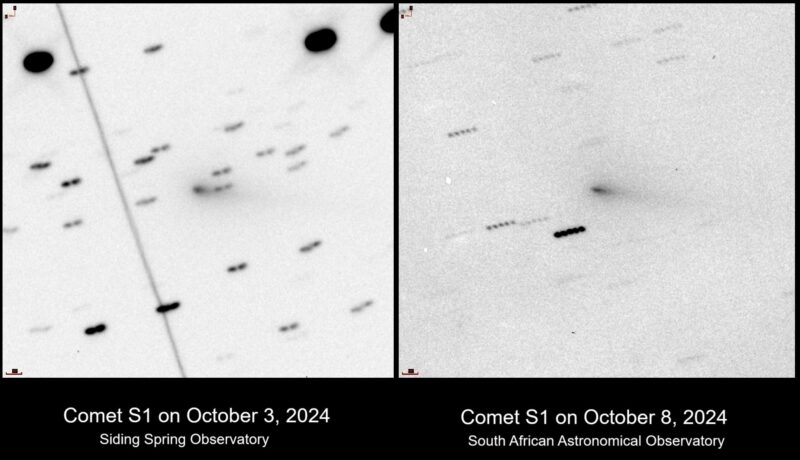
Astronomers said on October 9, 2024, in The Astronomer’s Telegram that it appears Comet S1 is disintegrating. They compared observations of Comet S1 from Australia’s Siding Spring Observatory on October 3 with observations from South African Astronomical Observatory on October 8. The astronomers said the nucleus, or central ice ball of the comet, “appeared elongated and fainting” on October 8 compared to the October 3 images. They reported:
This finding suggests a possible fragmentation of the nucleus.
Despite the comet was still at a relatively ‘safe’ distance from the sun, it is possible that strong vaporization of a large amount of gas occurred which, together with the tidal or rotational forces acting on the comet’s nucleus, may have led to its fragmentation.
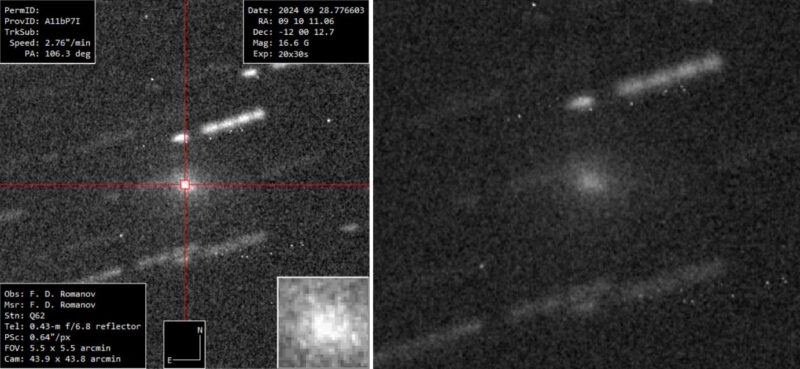
Announcement of the new sungrazer comet
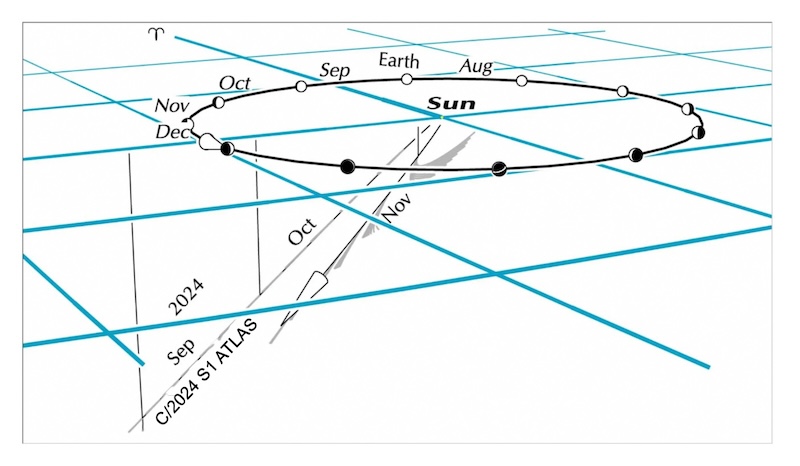
The ATLAS survey in Hawaii discovered another new comet that could become bright in Earth’s skies on September 27, 2024. It was first given the designation of A11bP7I, but now it’s officially C/2024 S1 (ATLAS). Predictions for the comet had it reaching as bright as magnitude -5 to -7 when it comes closest to the sun, at perihelion, on October 28. Will that still happen? We’ll have to wait and see.
The Southern Hemisphere should have the best view before perihelion. After its close encounter with the sun (if it survived) it could put on a fantastic show for the Northern Hemisphere in the morning skies. It would definitely be something to wake up early for.
But it this comet is kaput, don’t forget about the OTHER comet in Earth’s skies right now. C/2023 A3 Tsuchinshan-ATLAS should now start to appear in your evening sky just after sunset.
A BIG NEW SUNGRAZING COMET: Today, many astronomers are excited about a new comet discovered just a few days ago by the ATLAS survey. It’s so new, it doesn’t have a name yet, just the provisional designation “A11bP7I.” What’s the excitement about? A11bP7I is a sungrazer… pic.twitter.com/BeGArf7Orv
— The Watchmen Earth and Space Connection (@TWESC2023) September 30, 2024
A Kreutz sungrazer
The new sungrazing comet is part of the Kreutz sungrazers. These are comets that come perilously close to the sun, where they can disintegrate or, if we’re lucky, become fantastically bright. Many of the comets through history that have been given the name “Great” (for example the Great Comet of 1882, the Great Comet of 1106 and the Great Comet of 371 BCE) were all Kreutz sungrazers. More recently, Comet Ikeya–Seki in 1965 was a Kreutz sungrazer that became as bright as magnitude -11. That’s as bright as a first quarter moon.
Scientists believe Kreutz sungrazers all come from a big comet that broke up a couple of millennia ago. Most Kreutz sungrazers are small fragments, but this one may be larger than most.
Will it become as bright as Ikeya-Seki? Not likely. When the new comet was about 1 astronomical unit (AU) from the sun, it was about 4 to 5 magnitudes dimmer than Ikeya-Seki was at that distance.
Orbit of C/2024 S1 (ATLAS)
Bottom line: The new sungrazer comet gave us high hopes of a bright comet at the end of October. But it appears it has disintegrated during its close approach to the sun.
The post Sungrazer comet Comet S1 seems to have disintegrated first appeared on EarthSky.