

New comet C/2025 R2 (SWAN) is becoming more visible
New comet soars into the sky
There’s a new, fairly bright comet in the sky, discovered less than a week ago, on Friday, September 12, 2025. The Solar Wind Anisotropies (SWAN) instrument on the SOHO spacecraft detected it. And it’s relatively bright (as comets go), shining at around magnitude 6.2, as of September 16. That’s not quite bright enough to see with the eye, especially considering that the brightness of a comet isn’t point-like as stars are. Comets are “fuzzy.” But it’s bright enough to detect using binoculars, or a camera with a 200-mm lens.
The International Astronomical Union has now given the comet an official name: C/2025 R2 (SWAN). It was originally and temporarily designated SWAN25B.
Right now, the comet is in the west after sunset, not far from the planet Mars (see chart below). The comet appears among the background stars of the constellation Virgo. Its trajectory is currently under analysis. So it’s too early to determine if the comet will get brighter or fade, but good news is observers in the Northern Hemisphere might be able to get a glimpse of the comet, as it will gradually move away from the area where we see the sun. At the moment, it’s best positioned for observers in the Southern Hemisphere. Because it’s so close to the sun, it will be tricky to spot. Check out the finder map below.
The reported exact location in the sky at discovery was right ascension (RA) 13 08.5 and declination (DEC) -09 10.
More on the comet’s path
By comparing recent observations, NASA/JPL has been able to determine an orbit. It suggests this comet completes an orbit around the sun
every 22,554 years!
This means that if you are able to see the new comet C/2025 R2 (SWAN) using binoculars or with a camera, this will be a once in a lifetime sighting. If the comet survives this pass, it will return around year 24,579.
The International Astronomical Union estimates the comet will have its closest approach to Earth around October 12 – 19, 2025. And preliminary estimates predict it might get as bright as about magnitude 5.8. But only time will tell, considering that comets are so erratic and unpredictable.
The latest observations of Comet SWAN R2
Australian comet expert Michael Matiazzo captured a new image of the comet on September 14 (above). It shows an impressive, 2.5-degree-long tail, which translates to about 5 full-moon diameters long!
However, since a camera is more sensitive than the human eye, this does not mean you will see such a long tail if you see it visually.
Mattiazzo pointed out that the comet’s brightness has increased to around magnitude 6.9, while other observers say the comet might be even slightly brighter.
Although the new comet is currently very low on the western horizon, observers in the southern U.S. might get a glimpse of the celestial visitor – if it holds and doesn’t disintegrate – because every evening it’s getting slightly higher. So, it might become visible from the southern U.S. very soon.
In fact, an observer from Zacatecas, Mexico, photographed Comet SWAN R2. And observer Mike Olason reported that he was able to faintly capture the comet on September 13 from Tucson, Arizona, although extremely low in the horizon.
Meanwhile, observers in the Southern Hemisphere have been in the front seats during the first sightings of this surprising new comet.
Some images of the new comet
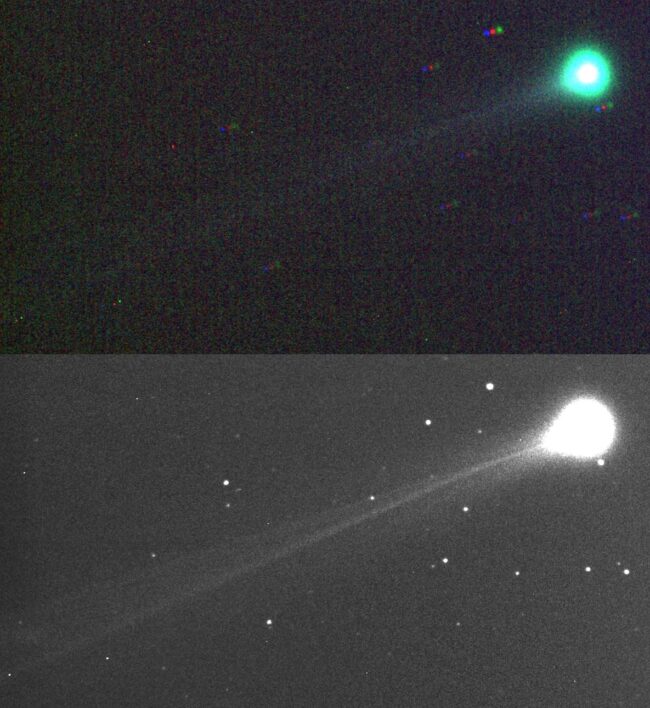
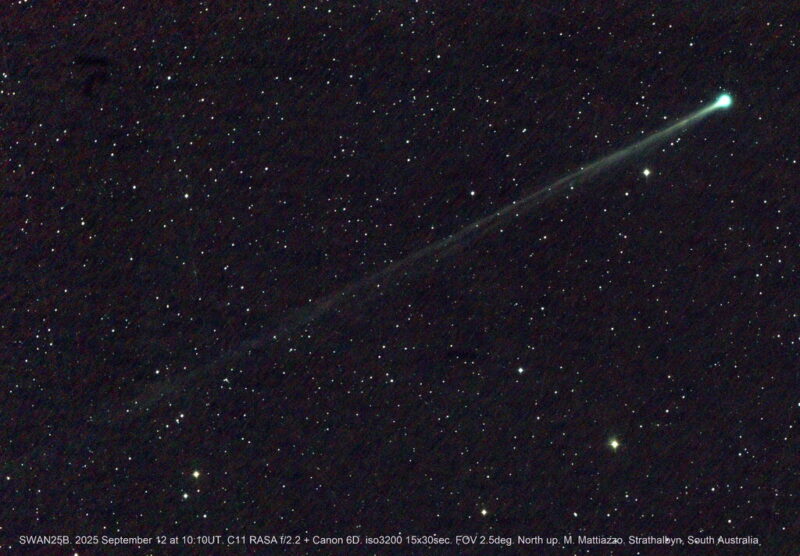
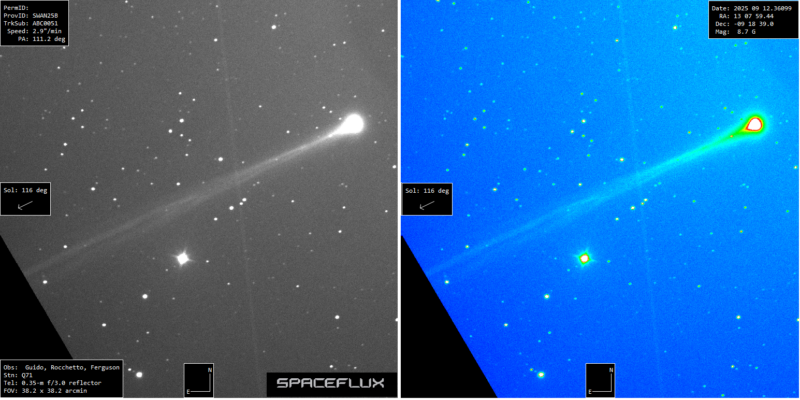
A finder map for comet SWAN R2
Want to see comet SWAN R2 for yourself? You’ll need a clear view to the western horizon after sunset. Look west after sunset in the direction where the sun has just disappeared. If you can find Mars, the comet is currently just below Mars. The comet will be passing below Mars and above Spica in Virgo. You’ll want to use optical aid.


Early observations of the new comet
Comet hunter Vladimir Bezugly detected the new comet in recent SWAN images. Meanwhile, comet astrophotographers are capturing nice images of the new celestial visitor. Comet expert Michael Mattiazzo said:
I was able to visually see it this morning (September 12) using 15 x 70 binoculars from Australia.
Martin Mašek of the Institute of Physics of the Czech Academy of Sciences, at the Cherenkov Telescope Array site near Cerro Paranal, also confirmed the new comet on the ICQ Comet Observations Facebook page. Mašek said:
I was very pleasantly surprised by such a bright comet with a long tail. I originally expected to be searching for a small, faint patch.
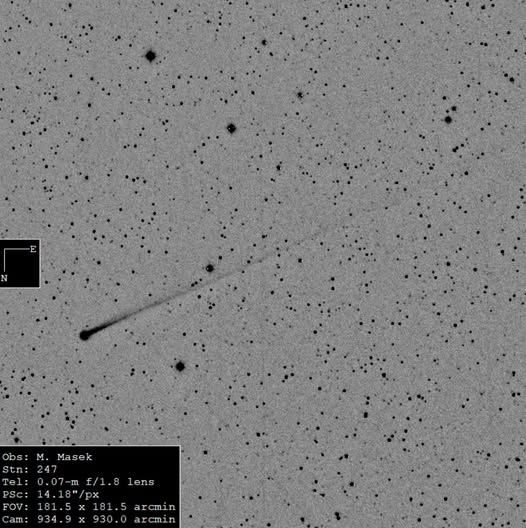
So why haven’t we seen this bright comet before now? The new comet was apparently behind, or too close to the area where we see the sun, and perhaps has appeared just after its perihelion. However, scientists are still comparing observations of the comet to determine its exact trajectory.
This is a developing story, so stay tuned for updates!
Bottom line: New comet C/2025 R2 (SWAN) is barely visible to the eye. Binoculars will show it! Right now, it’s near Mars, in the west after sunset.
The post New comet C/2025 R2 (SWAN) is becoming more visible first appeared on EarthSky.