

Artemis 1 scrubbed. Next possible launch September 2
Artemis 1 launch scrubbed due to fuel problem
An issue with temperature conditioning on one of the three main booster engines for the mighty SLS rocket has forced an end today’s Artemis 1 launch attempt. In case you haven’t been following it … Artemis 1 is the first of three missions planned to send humans back to the moon by the middle of this decade. And wow! It’s exciting. The next launch window will open at 12:48 p.m. ET (16:48 UTC) on Friday, September 2, 2022. Launch director Charlie Blackwell-Thompson made the call to scrub the mission at just after 8:30 a.m. ET today, at Kennedy Space Center in Florida, following repeated attempts by technicians to fix the issue.
Artemis 1 has all the dazzle of the earlier race to the moon in the 1960s … a giant rocket, with powerful thrust … an unmatched element of daring. It’s a big understaking. So it’s no surprise we didn’t launch on August 29. There are two alternate launch dates in the first week of September: the 1st and the 5th.
And, of course, spaceflight fans were disappointed. But many tempered their upset with good humor:
Artemisn’t
— b1joe (@b1joe) August 29, 2022
Here’s what happened
While the countdown was at a T-40 minute hold, the engineering team asked for additional time to continue working on a fix. Here’s what NASA said was going on:
While liquid oxygen loading into the interim cryogenic propulsion stage continues and core stage tanks continue to be replenished with propellants, engineers are troubleshooting an issue conditioning one of the RS-25 engines (engine 3) on the bottom of the core stage. Launch controllers condition the engines by increasing pressure on the core stage tanks to bleed some of the cryogenic propellant to the engines to get them to the proper temperature range to start them. Engine 3 is not properly being conditioned through the bleed process, and engineers are troubleshooting.
There also appeared to be a worrying crack in the thermal protection system on a flange of the core stage booster. However, NASA now says there is no crack in the booster itself, and fuel vapors venting through the thermal protection layer caused the issue. A similar issue was seen during the space shuttle era, and it did not affect flight safety.
Get updates on Artemis 1 via NASA’s Artemis blog
What Artemis 1 will do
Artemis 1’s objective is partly to test SLS, a vehicle comparable to the great Saturn V that carried the first astronauts to the moon in the Apollo program of the ’60s and ’70s.
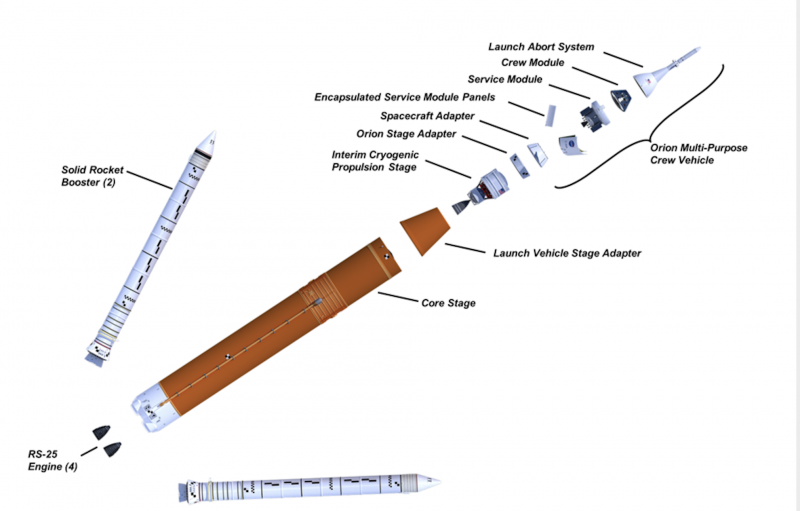
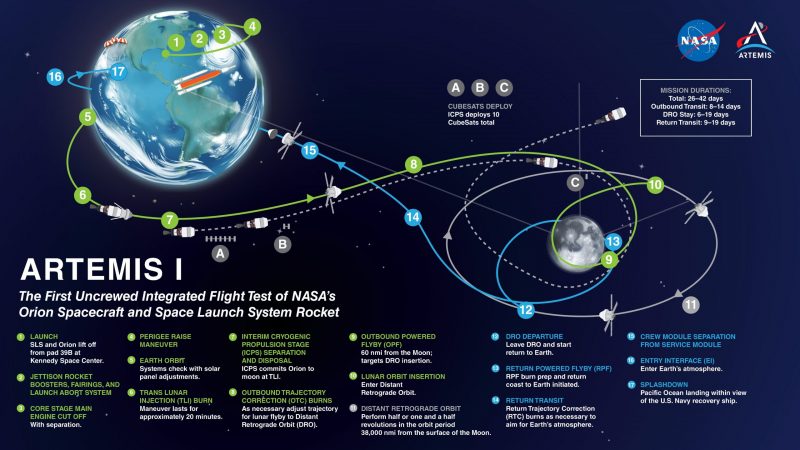
SLS – the world’s tallest rocket – is far more advanced than the Saturn V, technologically. But its main purpose is thrust. SLS will produce 8.8 million pounds (3.9 million kg) of thrust during liftoff and ascent, 15% more than the Saturn V. It’ll need that much thrust to loft a vehicle weighing nearly 6 million pounds (2.7 million kg) to orbit. Propelled by a pair of five segment boosters and four RS-25 engines, the rocket will reach the period of greatest atmospheric force within 90 seconds, NASA says. After jettisoning its boosters, service module panels, and launch abort system, the core stage engines will shut down. At that point, the core stage will separate from the Orion spacecraft.
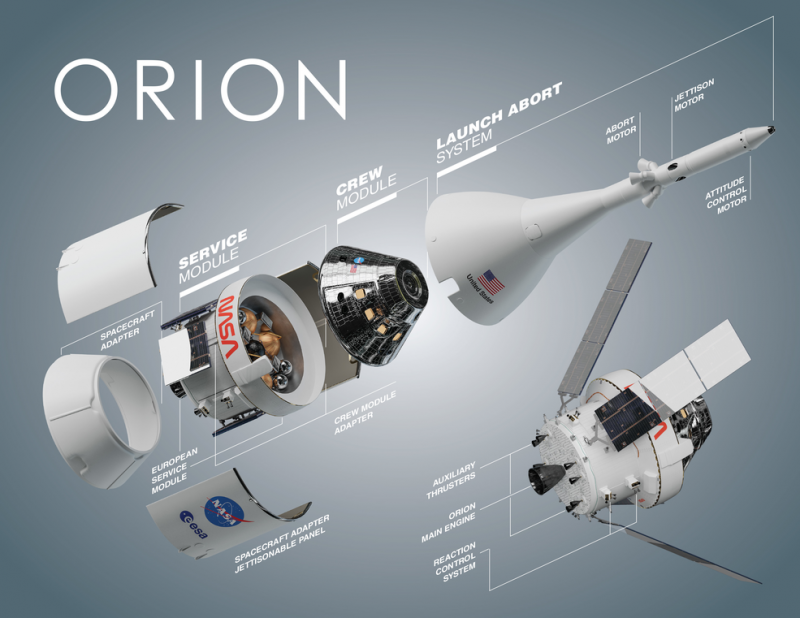
The Orion moonship is known officially as the Orion Multi-Purpose Crew Vehicle or Orion MPCV. It’ll go to Earth orbit atop of SLS following launch. There, it’ll deploy its solar arrays and the Interim Cryogenic Propulsion Stage (ICPS) that’ll give the craft the big push needed to leave Earth’s orbit and travel toward the moon.
Orion already underwent an Earth-orbiting test in 2014, so this isn’t its first voyage to space. But it is its first trip to the moon, and it’ll get there via propulsion by a service module provided by the European Space Agency. The service module will supply the spacecraft’s main propulsion system and power (as well as house air and water for astronauts on future missions).
Orion will fly as close to the moon’s surface as about 62 miles (100 km). It’ll use the moon’s gravity to propel itself into an orbit about 40,000 miles (70,000 km) from the moon.
The spacecraft will stay in that orbit for about six days, collecting data. During that time, mission controllers will assess its performance. Then it’ll perform a second close flyby of the moon, coming within about 60 miles (100 km). Another precisely timed engine firing of the European-provided service module – in combination with the moon’s gravity – will accelerate the moonship back toward Earth. It’ll enter our planet’s atmosphere traveling at 25,000 mph (11 km/second), producing temperatures of approximately 5,000 degrees Fahrenheit (2,760 degrees Celsius). So it’ll go faster – and get hotter – than during its 2014 flight test.
In all, the mission will last about a month and travel a distance of 1.3 million miles. It’s expected to make a precision landing within eyesight of the recovery ship off the coast of Baja, California.
The roll-out of of SLS and Orion
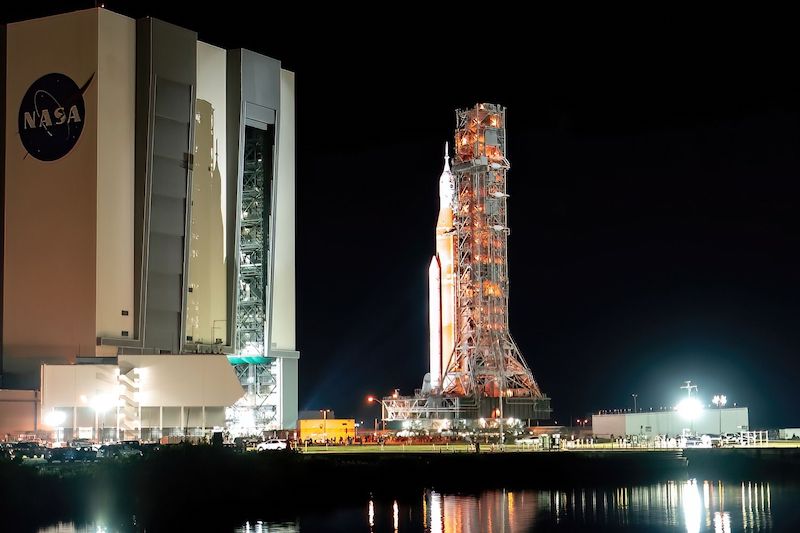
NASA technicians rolled the SLS out to Launch Pad 39B at Kennedy Space Center in Florida on August 16, several days ahead of schedule. NASA seems as eager as the rest of us to get its mighty SLS off the ground. The rollout took 10 hours and 8 minutes, while the moon rocket crept along at a maximum speed of 0.8 mph (1.3 kph) to the launch pad. Watch in the video below.
What’s in the crew capsule?
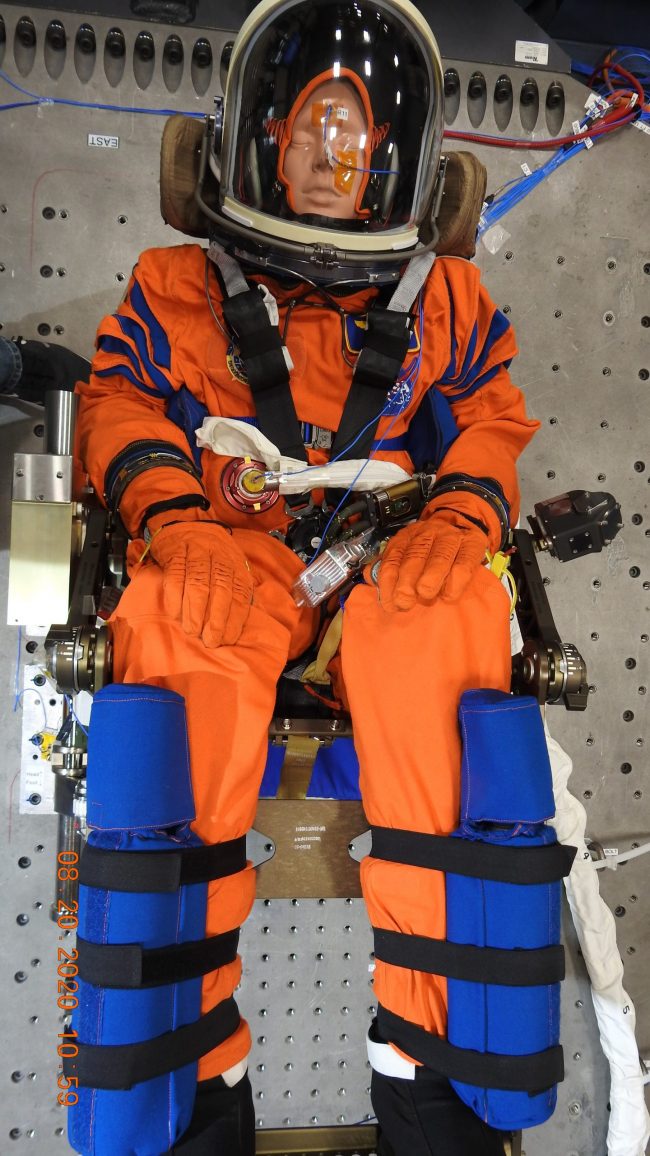
The Orion moonship won’t have a human crew during Artemis 1. Instead, the commander’s seat of the ship will be occupied by a mannequin dressed in a bright orange spacesuit known as the Orion Crew Survival System. NASA says the special suit is:
… designed for a custom fit and equipped with technology features to help protect astronauts on launch day, in emergency situations, throughout high-risk parts of missions near the moon, and during the high-speed return to Earth.
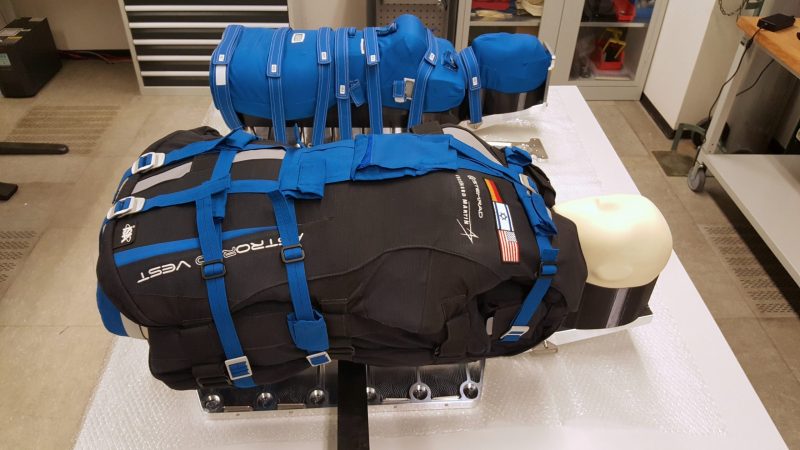
In addition, there will be two other “passengers,” two identical mannequin torsos equipped with radiation detectors. The Israel Space Agency and the German Aerospace Center designed this part of the mission. It’s an experiment to test the AstroRad radiation protection vest, which will provide data on radiation levels.
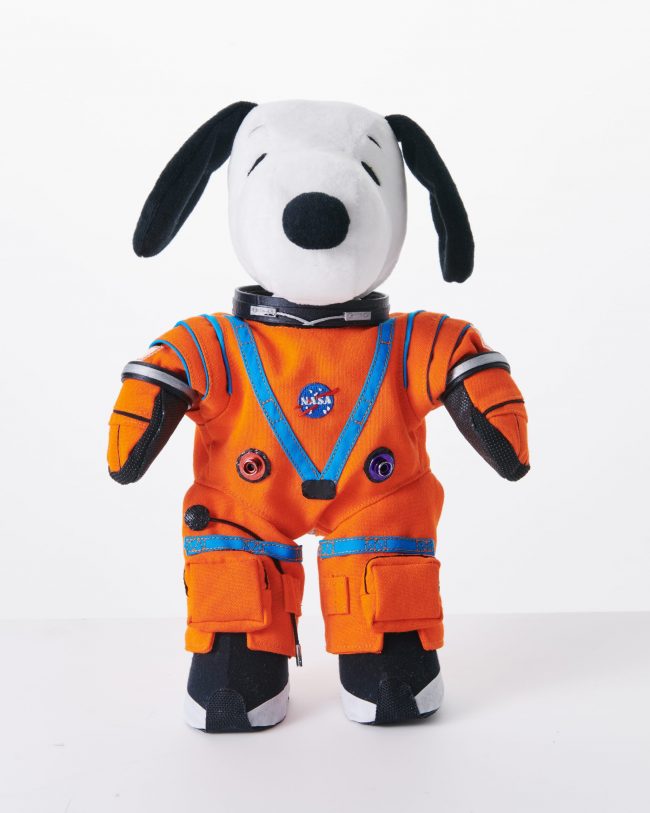
The mannequin and mannequin torsos will be strapped in. But NASA is also flying a “zero gravity indicator” in the form of a Snoopy cuddly toy, also dressed in an iconic orange NASA jumpsuit. The comic-book character Snoopy was a household name in the 1960s and ’70s, when the Apollo missions were flying. And Apollo 10 astronauts traveled to the moon for a final checkout, prior to the first human moon landing with Apollo 11 on July 20, 1969. Apollo 10 skimmed to within 50,000 feet of the moon’s surface, to “snoop around” (scout the Apollo 11 landing site). So the crew named its lunar module “Snoopy.”
There have been delays
Many earthly spacecraft have visited the moon, but it has been 50 years since humans have walked its surface. And space visionaries have been dreaming for decades of a return to the moon. Although NASA first announced the Artemis program in December 2017, the development of the Orion crew capsule and the powerful SLS began earlier, in 2011. SpacePolicyOnline reported on March 14, 2022:
The first flight of SLS/ Orion has been delayed again and again. In 2014, NASA committed to the first launch in November 2018. That slipped to December 2019-June 2020, then to mid-late 2021 and then to 2022. Now, at long last, they are almost ready to take flight.
Read more SLS/ Orion history at SpacePolicyOnline, if you’re interested.

A return to the moon
Ultimately, the Artemis program aims to send the first humans back to the moon by the middle of this decade. When they go, they’ll be aiming for the moon’s south pole, a place that scientists have discovered in recent decades has large amounts of water ice. Water contains oxygen, so processing it will make it possible for future astronauts to stay longer.
Someday, visionaries still hope, we will have a permanent presence on the moon. And we will go to Mars.
Such dreams are an integral part of humanity’s natural wanderlust in the 21st century. And so future historians might look back at our time – and at the Artemis missions – as the moment humanity took a true giant leap to space, maybe this time for good.
We are going.
As @NASA prepares to send astronauts to the Moon under #Artemis, we have identified 13 candidate landing regions near the lunar South Pole.
Learn about the landing regions and what sets them apart: https://t.co/XagoqjMi9b pic.twitter.com/lUwJun9yh0
— NASA Artemis (@NASAArtemis) August 19, 2022
Get a visual of what Artemis will be doing
Artemis 1 launches Monday on a 6-week round trip to the Moon. Trajectory courtesy of @NASAJPL Horizons.#Artemis @NASAArtemishttps://t.co/mE2FbLuDSB pic.twitter.com/ZHgqgBrhQ6
— Tony Dunn (@tony873004) August 25, 2022
Bottom line: The August 29, 2022, attempt to launch Artemis 1 – the 1st step in a human return to the moon – has been scrubbed. Next launch window opens September 2.
The post Artemis 1 scrubbed. Next possible launch September 2 first appeared on EarthSky.