

Interstellar object 3I/ATLAS brightening quickly
Comet 3I/ATLAS is brightening more quickly than expected
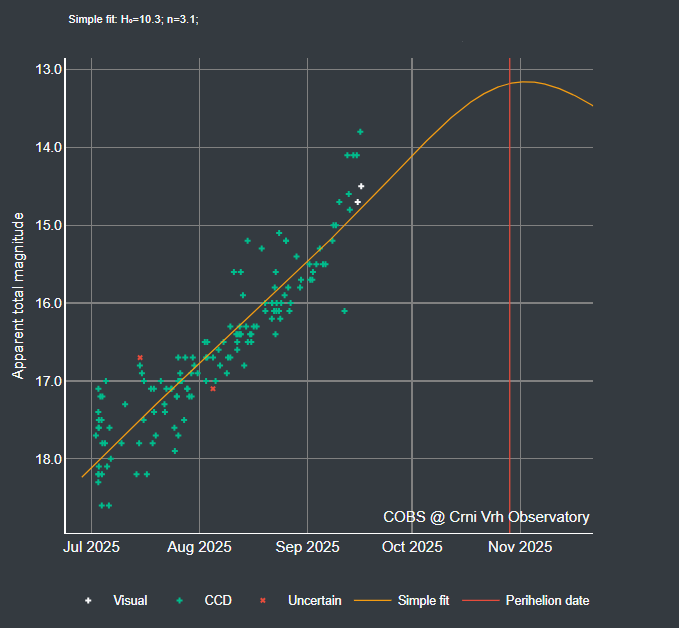
The most recent observations of our new interstellar visitor, Comet 3I/ATLAS, show it brightening more quickly than predicted. Up until now, the interstellar comet had been brightening as expected. But the observations from mid-September 2025 are beginning to rise above the upward-sloping line of brightening that would have been typical for a comet nearing the sun. Of course, comets are notoriously unpredictable. So does the increase in brightness mean the comet will outperform predictions? Or is this just a temporary outburst? Only time will tell.
As the comet comes closer to the warmth of the sun, the water ice on its surface will sublimate (turn directly to gas). The process of sublimation ejects dust particles that were embedded in the comet’s head. And this gas and dust is the bright, fuzzy coma that we see, along with its tail.
If it maintains its brightness, it could put on a good show as it passes Mars on October 3. Comet 3I/ATLAS will make its closest approach to Mars at 4:00 UTC on that date (11 p.m. CDT on October 2). And some of the attendant spacecraft, normally focused on the red planet, will peer at the interstellar visitor instead. As Marshall Eubanks of Space Initiatives said:
During the Mars close approach, the Mars Reconnaissance Orbiter will observe 3I with HiRISE, observing between 1 – 4 a.m. on October 2, and the CaSSIS camera on ESA’s Trace Gas Orbiter (TGO) and the Mars Express’s High Resolution Stereo Camera (HRSC) will be observing on October 3.
Interstellar object 3I/ATLAS: A look backward
A team of scientists, led by Xabier Pérez-Couto of the University of A Coruña in Spain, has traced the path of interstellar object 3I/ATLAS back 10 million years. This is only the 3rd-known object found traveling in our solar system that didn’t originate with our sun and its planets. Its trajectory tells us it must have come from another star system, but which one? The astronomers were seeking its origin star, or any stars that might have perturbed its path as it traveled from its point of origin to our solar system.
The researchers examined 3I/ATLAS’s trajectory with the help of the Gaia space observatory’s data on stars. For 12 years, Gaia collected data on billions of stars in our Milky Way galaxy, precisely noting their positions again and again and thereby determining their motions. These astronomers’ calculations took them more than 100 million astronomical units (AU, or Earth-sun units) from our solar system. With these data in hand, researchers said they identified 93 nominal “encounters” for 3I/ATLAS, 62 of which were “significant.” Yet, they found that none of those encounters produced any meaningful perturbation of ATLAS’s orbit.
So, in other words, all of those 93 (or 62) encounters happened too fast, with the stars too far from 3I/ATLAS to meaningfully impact its trajectory. In the end, they didn’t find a star along 3I/ATLAS’s path that might have been responsible for bringing this 3rd-known interstellar object to us.
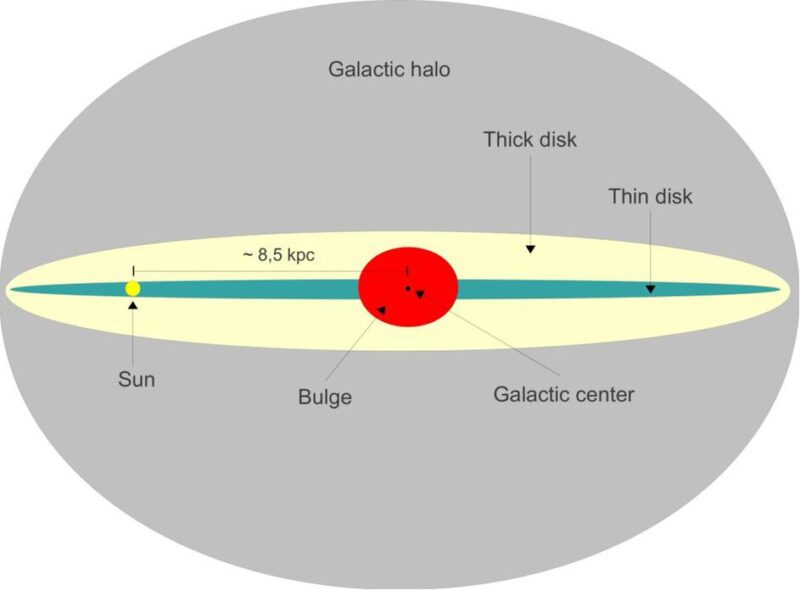
And, as you might imagine, tracing 3I/ATLAS’s path backward through the galaxy is a daunting task. That’s in part because small uncertainties in orbits and stellar motions grow rapidly over time. But based on the researchers’ analyses of the interstellar object’s vertical motion in the galaxy (its path is known to weave up and down in the galactic disk), they concluded that it likely originated from the Milky Way’s thin disk, not its thick disk as was mentioned some months ago. The thin disk contains somewhat younger objects than the thick disk. But the researchers’ paper said:
[3I/ATLAS] may nonetheless be an old object, consistent with ejection from a long-lived primordial planetesimal disk in an early-formed system.
The scientists published their not-yet peer-reviewed paper on arXiv on September 10, 2025.
Unlocking galactic mysteries with 3I/ATLAS
3I/ATLAS is thought to have been drifting through interstellar space for many billions of years before encountering our solar system. Pérez-Couto and team said that the interstellar comet is a:
… key probe of the galactic population of icy planetesimals.
In other words, the formation of solar systems is a messy process. In a solar system’s earliest days, rocks and pockets of gas and dust bang into each other and get swept up into clumps, which eventually get big enough to begin gathering yet more rocks, gas and dust to themselves via the force of gravity. Thus planets come to be, astronomers think. According to theories of planet formation, clearing processes are also common, and those sometimes involve material – often the outer, icy regions of debris – getting ejected from a system altogether. As the paper said:
… interstellar space should be filled with planetesimals.
And there are other ways these interstellar interlopers might have achieved their lonely paths through our Milky Way galaxy. The possibiities range from close passages of other stars to tidal fragmentation of comets. So, as the paper said:
Identifying the origin of interstellar objects is key to understanding planet formation efficiency, the distribution of volatiles and organics in the galaxy, and the dynamical pathways by which planetary systems evolve.
All that from a small chunk of icy stuff (we know it’s icy in part because 3I/ATLAS has formed a tail, as icy comets do)!
EarthSky interview with Colin Snodgrass
Scientists first spotted 3I/ATLAS in early July 2025. And since then, one question has been asked countless times: will we send out a spacecraft to take a closer look? EarthSky’s Will Triggs spoke to University of Edinburgh astronomer Colin Snodgrass on August 21, 2025, to find out the answer. Colin essentially said, no, we don’t have time to organize a space mission specifically for 3I/ATLAS. But he talked about a future mission, the European Space Agency’s Comet Interceptor. This upcoming spacecraft will be primed to intercept future interstellar objects. Watch Will’s interview with Colin in the player below, or on YouTube.
It’s worth noting that the behavior of 3I/ATLAS is much like the signature of previously seen sun-bound comets originating within our solar system. But 3I/ATLAS is moving fast. It’s traveling through our solar system at roughly 210,000 kilometers per hour (130,000 mph). That’s the highest velocity ever recorded for a solar system visitor.
EarthSky interview with Colin Orion Chandler
A month ago, on August 7, 2025, NASA shared an updated estimate of the size of the object’s nucleus, or core. Shortly after the object was first identified on July 1, 2025, 3I/ATLAS was estimated to have a diameter of about 20 km (12 miles). Then in late July – using data from the new Vera C. Rubin Observatory in Chile – the size estimate dropped to 10 km (6 miles). The latest analysis uses data from the NASA/ESA Hubble Space Telescope. It reduces the estimated diameter of 3I/ATLAS’s nucleus still further, to 5.6 km (3.5 miles).
And, the astronomers using Hubble data said, the object could be even smaller, as small as 320 meters (1,050 feet) across!
EarthSky’s Deborah Byrd interviewed Colin Orion Chandler of the DiRAC Institute of the University of Washington about size estimates for 3I/ATLAS. Watch in the player below, or on YouTube.
By the way, the two previously known interstellar objects are 1I/ ‘Oumuamua and 2I/Borisov. ‘Oumuamua’s size is thought to be about 200 meters across at its widest (you’ll recall it has an elongated shape). And Borisov is thought to be less than a kilometer across.
What’s 3I/ATLAS made of?
A team of astronomers, led by Bin Yang of the Instituto de Estudios Astrofísicos in Chile, said Comet 3I/ATLAS has abundant water ice. In addition, they found the comet has a dust composition more similar to D-type asteroids. In our solar system, D-type asteroids are those which orbit a bit farther out than main belt asteroids. Scientists think D-type asteroids contain organic-rich silicates, carbon and anhydrous silicates.
An early EarthSky interview with Matthew Hopkins
Shortly after the discovery of 3I/ATLAS – on July 1, 2025 – astronomers were saying it was likely the oldest comet we’ve ever seen. That claim came from University of Oxford astronomer Matthew Hopkins, whose analysis suggested 3I/ATLAS might be more than 7 billion years old, predating our solar system by more than 3 billion years! Hear him explain in the player below, or on YouTube.
How they spotted interstellar object 3I/ ATLAS
The Asteroid Terrestrial-impact Last Alert System (ATLAS) – a system of survey telescopes – detected our new interstellar visitor on July 1, 2025. And the Minor Planet Center confirmed its interstellar nature the following day (July 2, 2025), naming it 3I/ATLAS (or C/2025 N1). The “3I” means it’s the 3rd interstellar visitor that we’ve found. Its trajectory and speed revealed it as an object not from our solar system, but from another star system.
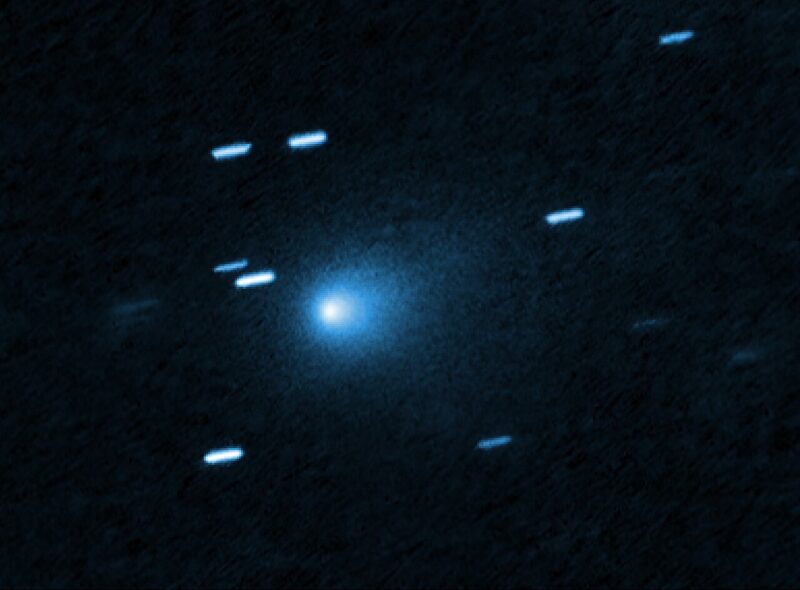
The Hubble Space Telescope imaged the object on July 21, 2025. See the post from Bluesky below.
Hubble Space Telescope images of interstellar comet 3I/ATLAS are out! These were taken 5 hours ago. Plenty of cosmic rays peppering the images, but the comet’s coma looks very nice and puffy. Best of luck to the researchers trying to write up papers for this… archive.stsci.edu/proposal_sea… ?
— astrafoxen (@astrafoxen.bsky.social) July 21, 2025 at 4:28 PM

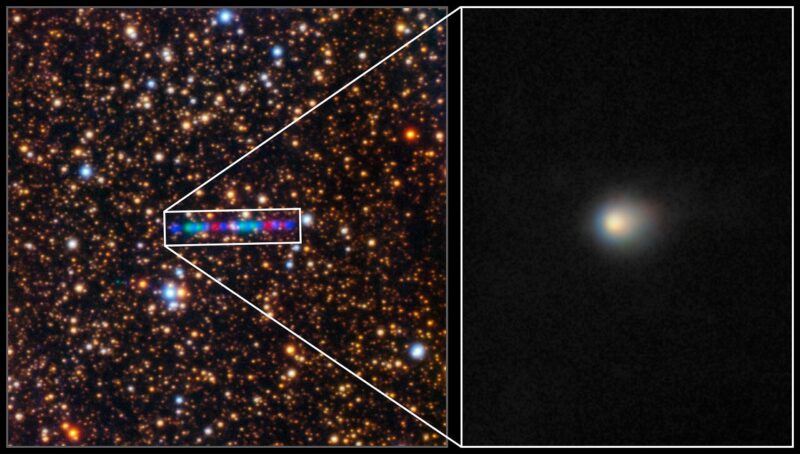
It’s still heading sunward
Our new visitor will get its closest to the sun – at about 2 astronomical units (AU), or twice as far as Earth is from the sun – in October. As it reaches perihelion – its closest point to the sun – it will be traveling at almost 15,500 miles per hour (25,000 kph).
The speedy nature of Comet 3I/ATLAS is another indication of its interstellar nature. It has to be moving at a blistering pace in order to escape the sun’s gravitational pull.
Marshall Eubanks, a physicist and VLBI radio astronomer and co-founder of Space Initiatives, said the comet will come within about 0.4 AU of Mars in October. That would make it just barely observable by the Mars Reconnaissance Orbiter.


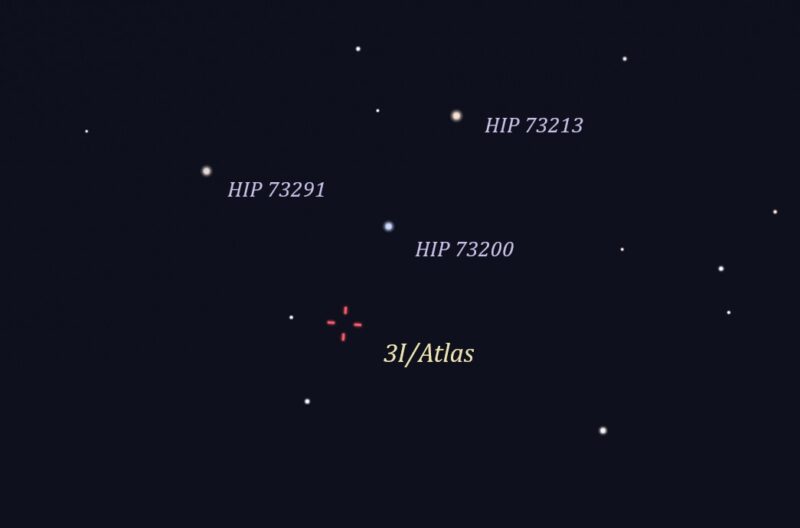
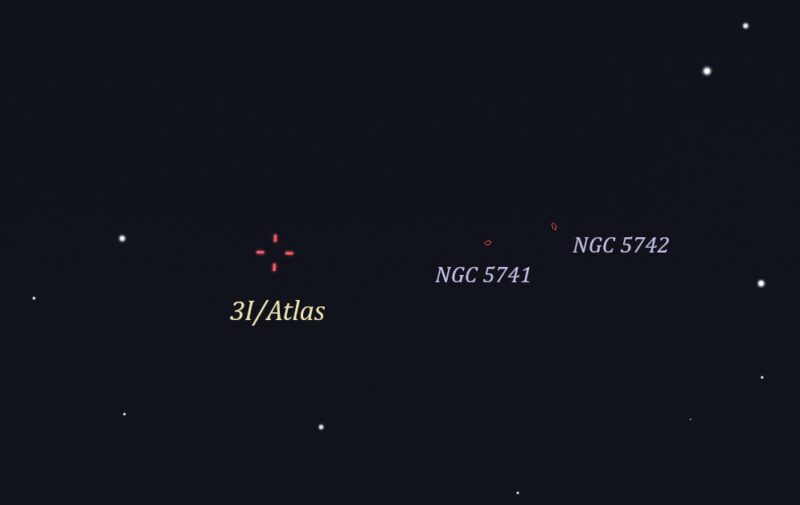
Evening star charts here
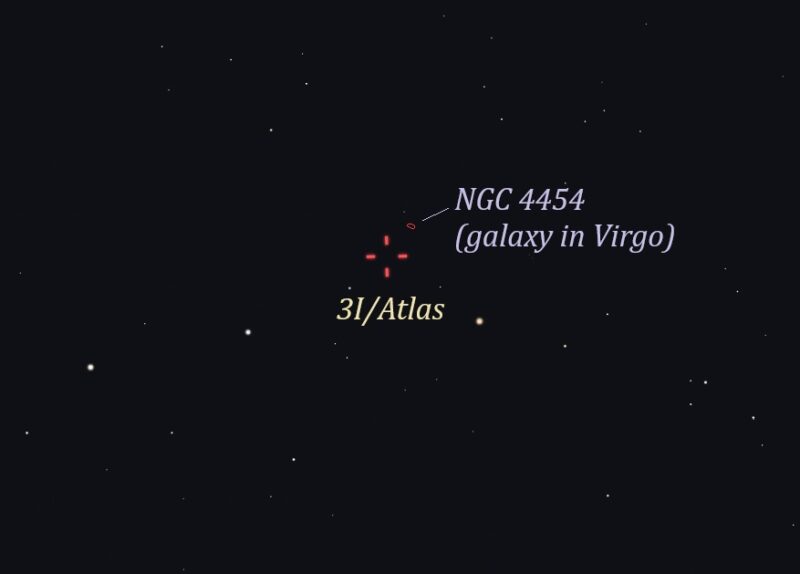
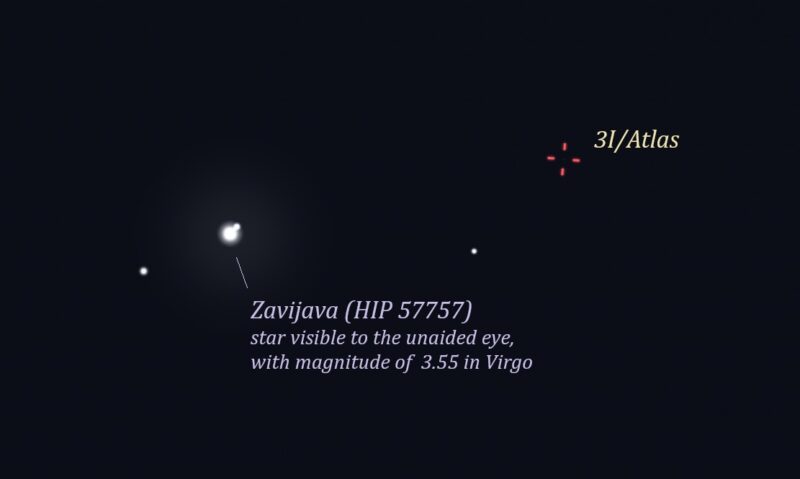
Morning star charts here
After Comet 3I/ATLAS makes its close approach to the sun, you can find it in the morning sky.
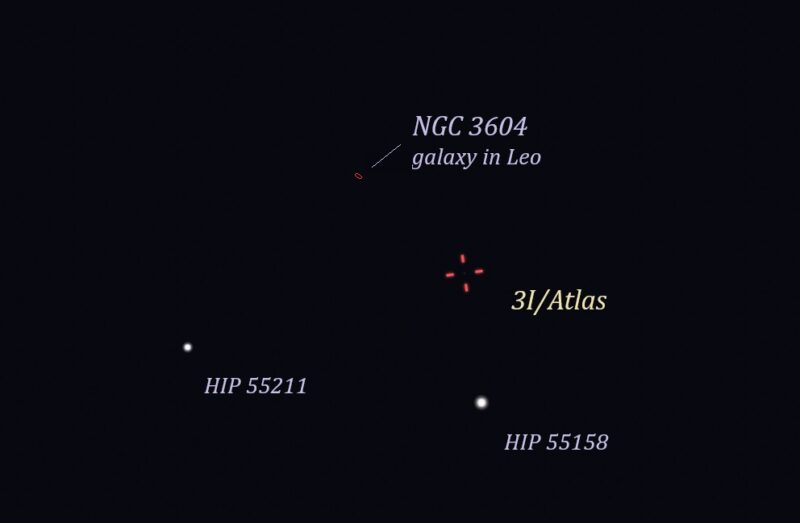
Bottom line: Interstellar object Comet 3I/ATLAS appears to be brightening more quickly than expected. The comet will make a close pass by Mars on October 3.
The post Interstellar object 3I/ATLAS brightening quickly first appeared on EarthSky.