

Remember when DART struck an asteroid? HERA is the follow-up
Join EarthSky’s Deborah Byrd and Michael Küppers, Project Scientist at the European Space Astronomy Centre, for a chat about Hera! They’ll be speaking LIVE at 12:15 p.m. (17:15 UTC) on Tuesday, October 1.
Hera is ready to launch!
The long-awaited Hera mission, which will follow the wildly successful DART mission that struck and moved an asteroid in 2022, is scheduled to launch on October 7, 2024. Hera will launch from Kennedy Space Center. The current date and time of launch, according to NASA, is at 14:52 UTC (10:52 a.m. EDT) on October 7, 2024.
The launch window is open until October 25.
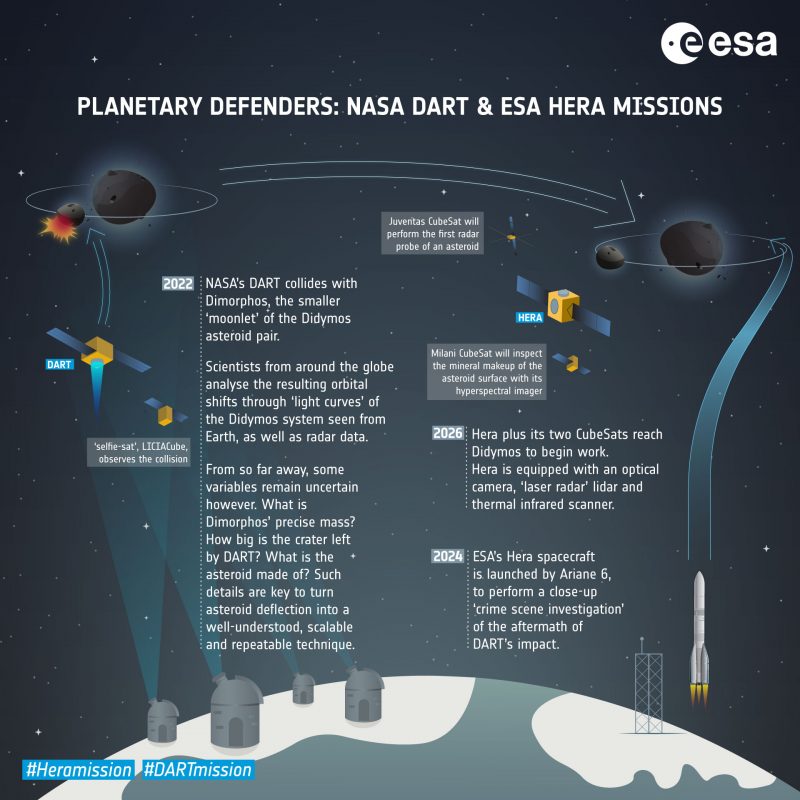
When DART hit Didymos’s little moonlet Dimorphos, it made a big splash, kicking up debris and pushing the asteroid slightly out of its previous orbit. And it might even have created a new meteor shower for Earth! Hera is going to learn more about just what happened when DART struck the little asteroid, creating a crater on its surface and moving it slightly in orbit.
Following a successful launch, Hera should arrive at the asteroid Didymos and its smaller moon Dimorphos in about two years to conduct a “crime scene investigation,” as ESA – the mission planner – said.
Here are 3 mysteries that Hera will help solve
2) Hera will map the crater created by DART’s impact down to 10 cm resolution to help scientists better understand how the surface material responded to the collision. It’s possible that there is no crater at all, rather the impact reshaped the entire asteroid! pic.twitter.com/jmp7K4MXjT
— ESA’s Hera mission (@ESA_Hera) September 26, 2024
Hera’s investigation of Dimorphos and Didymos will complete the story that DART began two years ago and turn asteroid deflection into a well understood and repeatable technique for protecting Earth from a potential asteroid impact. Stay tuned for launch next month!… pic.twitter.com/L3Wjg16U7m
— ESA’s Hera mission (@ESA_Hera) September 26, 2024
Meet the Hera mission
The original plan was for DART and Hera to work as a double spacecraft, but over the years of planning, they became separate missions. Ian Carnelli of ESA’s Hera mission said:
The pair are designed to function separately … their overall science return will be boosted greatly by being able to combine their results.
While scientists closely monitored the 2022 DART impact from Earth, the earthly observations didn’t tell scientists many things about Dimorphos that Hera can learn from close range. So, Hera will inspect the asteroid moonlet to determine its precise mass, what it’s made up of, whether it’s solid or a loose pile of rubble, and what exactly the DART impact crater looks like.
Hera’s contributions
Besides the main spacecraft, Hera will deploy two shoebox-sized satellites. Milani is in charge of spectral surface observations (splitting bounced light from the surface into a rainbow array of colors, then analyzing that light), and Juventas will take the first radar soundings in the heart of an asteroid.
The #HeraMission for asteroid planetary defence will take selfies once in space – here is the approximate field of view of its Spacecraft Monitoring Camera, looking over Hera’s instrument-hosting ‘Asteroid Deck’ https://t.co/VqXqgiRqKV pic.twitter.com/KBJKM6jl3H
— ESA’s Hera mission (@ESA_Hera) September 27, 2024

Bottom line: The Hera mission is scheduled to launch from Kennedy Space Center on October 7, 2024. Hera will explore the asteroid Dimorphos, which the DART mission hit as a test of planetary defense in 2022.
The post Remember when DART struck an asteroid? HERA is the follow-up first appeared on EarthSky.