

Will sungrazing Comet MAPS survive the sun?
Will this sungrazing comet survive and get bright?
Skywatchers have been tracking a new sungrazing comet, one that will sweep exceedingly close to the sun – maybe only 1% of Earth’s distance – on Aoril 4, 2026. It’s called C/2026 A1 (MAPS). Comets like this tend to appear brightest around their perihelion passages (closest points to the sun). If it survives its perihelion passage, this comet might become visible in Earth’s sky in the week after Easter, beginning around April 6. That’s why some people are calling it the Easter comet! Finder charts below. And EarthSky’s Deborah Byrd, along with veteran comet-watcher Bob King, have the details on when and where to look for the comet, in the video below.
Brighter than expected when far from the sun
Why do we think it might get bright? For one thing, this comet was shining at around 18th magnitude when it was still twice Earth’s distance from the sun. Magnitude 18 is much too faint to see with the eye. But it’s bright for a comet at that distance.
In fact, it might be the farthest from the sun astronomers have seen of a comet like this one. Its orbit suggests it’s a Kreutz sungrazer, one of a family of comets that sweep extremely close to the sun. Comet 2026 A1 (MAPS) is on its way to perihelion, its closest point to the sun, on April 4-5, 2026. Seeing it this early suggests it could be decently sized.
Preliminary observations indicated the newly found comet’s nucleus might have a diameter of up to 1.5 miles (2.4 km) across. However, recent observations made with the James Webb Space Telescope suggest this comet might have about a 0.25?mile (400 meter) diameter nucleus, similar to or slightly smaller than that of C/2011 W3 (Lovejoy).
Will this comet be visible to the eye alone?
Observing astronomical events requires patience. And that’s especially true for comets. Sensationalist headlines lead to high public expectations followed by disappointment. Comet MAPS might get bright enough to see in twilight in early April. But that’s when the object is extremely close to the sun, making it difficult to find. For a comet like this, you’ll have to get your timing just right. Too early, and bright twilight will hide the comet from view. Too late, and the comet will have set.
Now, the good news! If the brightening trending continues as projected, Comet MAPS might still provide some nice views.
- By March 21, 2026, the comet might reach a magnitude around 8.5 , visible in small telescopes.
- By March 26, it might reach a magnitude around 6.7. That would put it possibly visible in binoculars, but very low in the west just after sunset, and only from some locations in lower latitudes.
- By March 31, it might be at 3.4 magnitude (in theory visible to the unaided eye). However, it will be close to the horizon, and likely lost in the sun’s glare.
- By early April, if (a big IF) the comet is still intact, some interesting views might be in the offing.
More finder charts
If you have a computerized or “GoTo” telescope, you can use the March finder maps below to spot the comet. And anyone can start looking for the comet in late March and early April, when there is the possibility of seeing it with your eye alone.


Comet MAPS in April
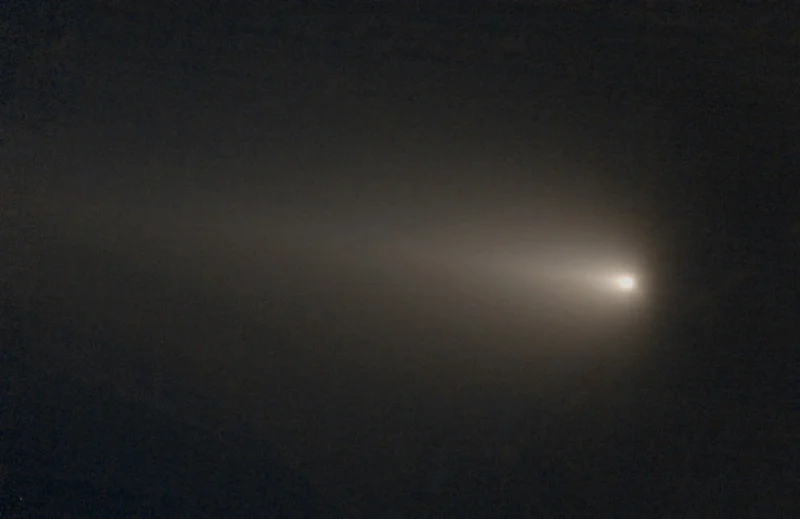
Perihelion – or closest approach to the sun – occurs around 9:18 CDT (14:18 UTC) on April 4, 2026. If the comet does not disintegrate, it might briefly become quite bright, with some estimates ranging from magnitude -5 (slightly brighter than Venus), to the incredible magnitude of -15 (brighter than the full moon). Keep in mind that even such a bright object might not be easy to see when it is next to the really bright sun, which has an apparent visual magnitude of -26.7 to -26.8.
And it’s also entirely possible the comet won’t get that bright. A magnitude of +1 to -2 is also possible: as bright as the brightest stars.
And here’s something key to consider. Observing any object close to the sun can be dangerous, with the risk of irreparable damage to the eye’s retina. Please … don’t chance looking for the comet when the sun is above the horizon. Only experienced observers know how to use a building or structure to block the sun and try to spot a nearby comet. You’ll need an unobstructed horizon – with the sun below the horizon – to spot it safely.
So is a good comet show still possible?
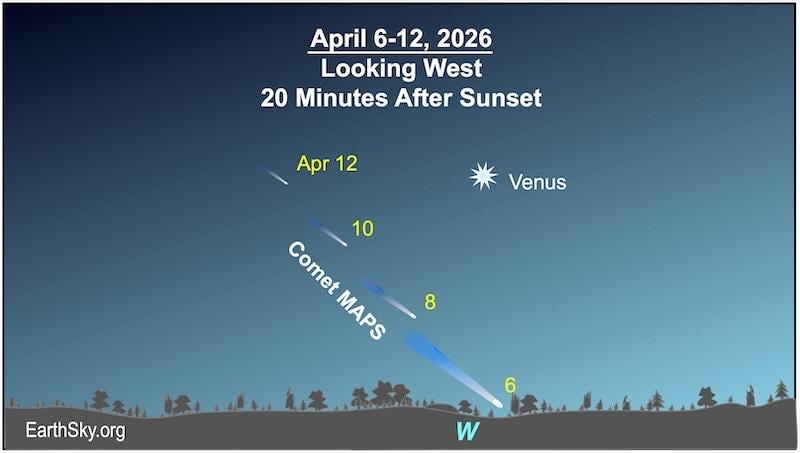
Yes. It’s possible. There is a slight possibility that we might get a safe-to-see spectacle in early April. If the comet survives, some time from April 4 to 11 a long cometary tail might appear close to the west horizon during or shortly after sunset.
Of course, this is still uncertain. Comets are erratic and unpredictable, and sungrazers add even more uncertainty.
Sungrazing comet discovery
The MAPS program, run by a group of French amateur astronomers using telescopes in Chile, discovered the comet on January 13, 2026. They used an 11-inch (0.28 meter) diameter telescope at San Pedro de Atacama, Chile. Their observation program, MAPS, is an acronym that stands for their last names: Maury, Attard, Parrott and Signoret.

How close will Comet C/2026 A1 MAPS get to the sun?
On April 4, 2026, Comet MAPS passes extremely close to the sun, at just 99,400 miles (160,000 km) from the photosphere, or sun’s surface. That’s closer than previous estimates suggested. In fact, it’s scorchingly close. The diameter of the sun itself spans 865,370 miles (139,2678 km).
Comets that get this close to the sun can disintegrate. The intense heat can force outgassing in the comet that rips it apart. Plus, the pull of the sun’s gravity can also cause it to fragment. On the other hand, if it does survive the intense heat of the sun and continue on its journey (outward now in its solar orbit), the comet might become quite bright in earthly skies. We would see it at dusk shortly after its closest approach to the sun, during the first week of April.
Bright sungrazers that have survived
And there is reason to hope the comet will survive! Other comets have passed even closer to the sun and survived. They’ve even become bright beacons in the night sky. For example, C/1965 S1 (Ikeya–Seki) came within 280,000 miles (450,000 km) of the sun. It ended up shining at magnitude -10. Observers called it the Great Comet of 1965. Then, more recently, C/2011 W3 (Lovejoy) came within 87,000 miles (140,000 km) of the sun in 2011. Ultimately, it shone at around magnitude -3 or -4, about as bright as Venus.
This kind of comet does not occur often. So this will be a rare opportunity for scientists to learn more about sungrazing comets.

What does the sungrazing comet look like now?
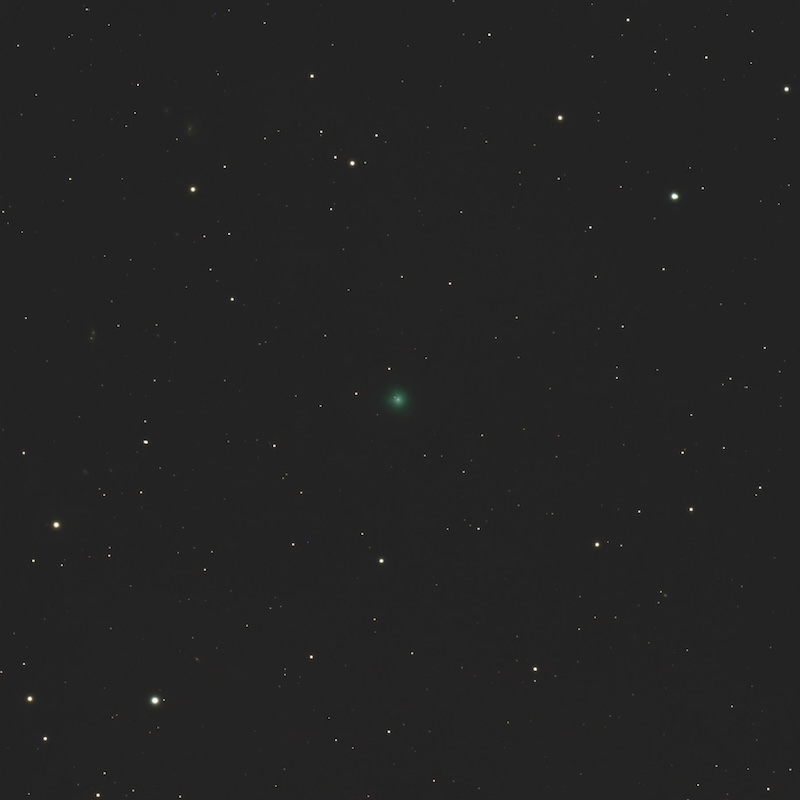
C/2026 A1 is already showing a small tail and diffuse green coma. The coloring suggest the emission of diatomic carbon (C2), a gas commonly seen in comets. The comet is currently in the constellation of Cetus the Whale, at a distance of around 115 million miles (185 million km) from Earth.
The comet will be closest to Earth on April 5-6, 2026, at a distance of more than 89 million miles (143 million km).


A possible fragment from a larger comet
Comet C/2026 A1 (MAPS) might be a fragment of a larger object from a type called Kreutz comets. These comets are named in honor of German astronomer Heinrich Kreutz.
Kreutz comets are a family of sungrazing comets. They pass extremely close to the sun. Scientists think they might be big fragments of a huge comet that broke apart centuries ago.
Comet MAPS was initially thought to belong to a group related to the Great Comet of 1843 and C/1963 R1 (Pereyra).
Recent observations suggest it last visited the interior of our solar system between 1,700 to 1,886 years ago. And astronomer Zdenek Sekanina from NASA/JPL said it might be related to a comet seen in broad daylight in the year 363, from what is now Antakya, Turkey.
These ancient observations were documented by Greek and Roman historian Ammianus Marcellinus.
Wait and see
The Conversation had this to say about Comet MAPS:
If it holds together, it might get bright enough to be visible in broad daylight. Even if that doesn’t happen, the SOHO spacecraft will provide great images of the comet.
In the days following perihelion, the comet will move into the evening sky. Thanks to its orbit, like all Kreutz comets it will be far easier to see from the Southern Hemisphere.
If the comet survives until perihelion, then fragments as it passes the sun, it could brighten suddenly and unexpectedly. A late break-up might therefore be the best-case scenario for a dazzling show.
Bottom line: Sungrazing comet C/2026 A1 (MAPS) has entered the field of view of the SOHO spacecraft.
Read more: The best comets of 2026: Here’s what to watch for
The post Will sungrazing Comet MAPS survive the sun? first appeared on EarthSky.